
09 What Khadijah Doesn't Say
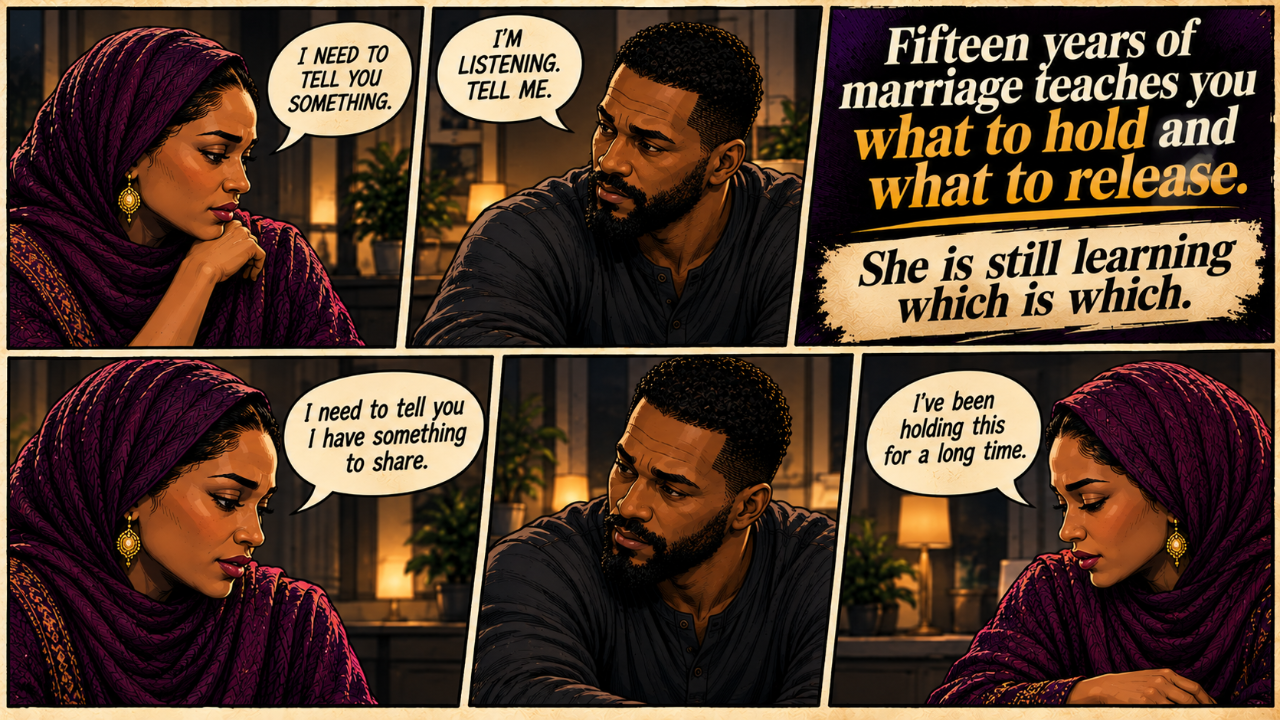
Fifteen years of marriage teaches you what to hold and what to release. She is still learning which is which.
If You Are New Here
This series follows three families navigating polygyny at different seasons.
Jamal and Aisha have been married 12 years and have four children. Jamal's second wife, Safiya, is a divorcee with one daughter. Eight months into polygyny. Aisha told the truth she had been holding. Jamal reached for her hand. A door opened that had been closed for months.
Marcus and Danielle have been married seven years and have two children. Marcus has been carrying the idea of a second marriage for fourteen months, researching it in private. He pulled into the driveway last week with the kitchen light on. He had rehearsed the first sentence.
Yusuf and Khadijah have been married 15 years and have five children. Yusuf's second wife, Mariam, is 29 and has been in the family for one year. No children yet. Both wives maintain separate homes. This week, we stay with Khadijah.
Because thriving has a look.
And then it has a cost.
And not everyone sees the cost.
The Gathering
Every few weeks, Yusuf's extended family rotates through someone's home.
Someone's food. Someone's children running loud through the hallway. The kind of gathering where the real conversations happen in the kitchen and the easy ones happen in the living room.
Khadijah had been hosting for fifteen years.
She knew this house in a way no one else did. She knew which chairs were uncomfortable and who would need the good one without being asked. She knew which cousins could not be seated next to each other. She knew when the evening was going long and how to start moving people toward the door without making it feel like an eviction.
This was her domain.
Then Mariam started coming.
That was the adjustment no book fully prepared her for.
Not the presence. She had made peace with the presence.
The adjustment was watching someone else learn what she already knew. Watching Mariam figure out the house. Figure out the family. Figure out where she fit inside a system that Khadijah had spent fifteen years building.
Some days Khadijah felt generous about that.
Some days she did not.
Tonight was one of the harder ones.
What She Noticed
Mariam was standing near the kitchen doorway.
Not doing anything. Just standing. Holding a glass she was not drinking from. Watching the room the way someone watches a room when they are trying to figure out where they belong in it.
Khadijah had been there.
Not in polygyny. In every room she had ever been the newcomer. Every family gathering she had walked into as Yusuf's young wife, fifteen years ago, when the aunties sized her up and the cousins were not sure what to make of her.
She knew that look.
And she had two choices.
She could leave Mariam there. Mariam was not her responsibility. She had her own home, her own grief, her own work to do inside this marriage.
Or she could cross the kitchen.
The first choice was easier. The first choice kept everything clean and separate. The first choice let Khadijah stay exactly in her lane.
She crossed the kitchen.
She stood next to Mariam. She did not say anything for a moment.
Then she said: "The chicken is better if you take it now. Once everyone else gets there, the good pieces are gone."
Mariam looked at her.
Then she laughed. A real one.
"Is that true?"
"I have been watching this family eat for fifteen years," Khadijah said. "Get the chicken."
They stood in the kitchen together for eleven minutes. They did not talk about Yusuf. They did not talk about the arrangement. They talked about the chicken, and the aunties, and which cousin was going to be the one who needed a ride home.
Small things.
But small things are where trust is built.
Khadijah knew that too.
The E Nobody Talks About
The E in the women's FRAME is Exclusive.
Most women hear that word and think it means something possessive. Something territorial. Something that requires protecting what is yours.
It does not mean that.
Exclusive means you are excellent within your own lane. You are so fully invested in your own marriage, your own growth, your own relationship with your husband, that you do not have the time or the interest to compete with another woman for space.
A woman at a low E is constantly looking sideways. Measuring herself against the other wife. Tracking what the other wife gets. Running calculations about fairness that never resolve in her favor.
A woman at a high E is running her own race.
Not because she does not feel. She feels everything.
Because she has decided that the only marriage she can actually improve is her own.
Khadijah's E is not a 10. She will tell you that herself.
There are nights she runs the comparisons. There are moments she catches herself watching Yusuf's face when he talks about his time at Mariam's home, and her brain starts doing the math it was never asked to do.
She does not stay there.
Not because she is perfect. Because she has practiced.
The cross-kitchen moment was not selfless. It was strategic in a way that had nothing to do with Mariam.
It was Khadijah deciding, again, who she was going to be inside this marriage.
That is the E.
For Husbands | For Wives
For Husbands
Watch the women in your home.
Not to referee. Not to manage. Not to manufacture harmony by telling each wife to get along.
Watch because the quality of the environment between your wives is a direct reflection of your leadership.
A husband who has done the internal work of equity, presence, and honest communication creates conditions where his wives can exist with dignity.
A husband who is managing the optics of polygyny without building the foundation of it creates conditions where every gathering feels like a performance.
Khadijah crossed the kitchen tonight because she is a woman of high character.
She also crossed it because Yusuf built a home worth being in.
Both things are true.
For Wives
You cannot control what the other wife does.
You cannot control how she feels, how she moves through the family, what she gets, what she says.
The only letter you are fully responsible for is your own.
If you find yourself tracking another woman's blessings instead of building your own, that is not discernment. That is a drain on energy that belongs to your marriage.
The woman across the kitchen from you is not your competition.
She is a woman navigating the same hard thing from a different angle.
What you choose to do with that fact is one of the most significant character choices you will make inside a plural marriage.
Quick Self-Check
For Women
- When you think about the other wife, are you measuring or building?
- What would it look like to run your own race so fully that comparison loses its grip on you?
- Is there something small you could do in the next week to create the conditions for peace — not because you have to, but because of who you have decided to be?
For Men
- What is the atmosphere in your home telling you about the quality of your leadership?
- Are you expecting your wives to create harmony on their own, or are you building the conditions that make harmony possible?
- When was the last time you expressed clearly that each woman is secure in your home?
Next Time
After the gathering, the family started leaving.
Mariam stayed.
She helped with the dishes for a while. Then she set down the dish towel.
She said: "Can I tell you something?"
Khadijah said: "Yes."
What Mariam said next stopped the room.
Not dramatically. Not in a scene.
In the way that very quiet truths stop you when they arrive without warning.
Your Next Move
Khadijah is doing the internal work that nobody else can do for her.
That is the job.
Not surviving polygyny. Becoming the version of yourself that this season is trying to build.
STEP ONE. Find your baseline. Your actual level, not the one you present in public. PolygamyQuiz.com
STEP TWO. The FRAME Playbooks for women were written for this exact moment. For women in plural marriages who want to stop running the comparison math and start running their own race. PolygamyBooks.com
STEP THREE. If you are in Khadijah's season and you want a guide through the internal work that a schedule cannot manufacture, coaching is where this starts. By interview only. PolygamyCoaching.com
This work is not designed for your comfort. It is designed to qualify you.
Your Favorite Relationship and Polygamy Coaches, Coach Nazir, Coach Fatimah, and Coach Nyla
Stay Educated, Equipped, & Engaged with private emails.

Find Out Where You Stand in Polygamy
A 6-min diagnostic used by polygamous families.