
The Word She Made Him Say
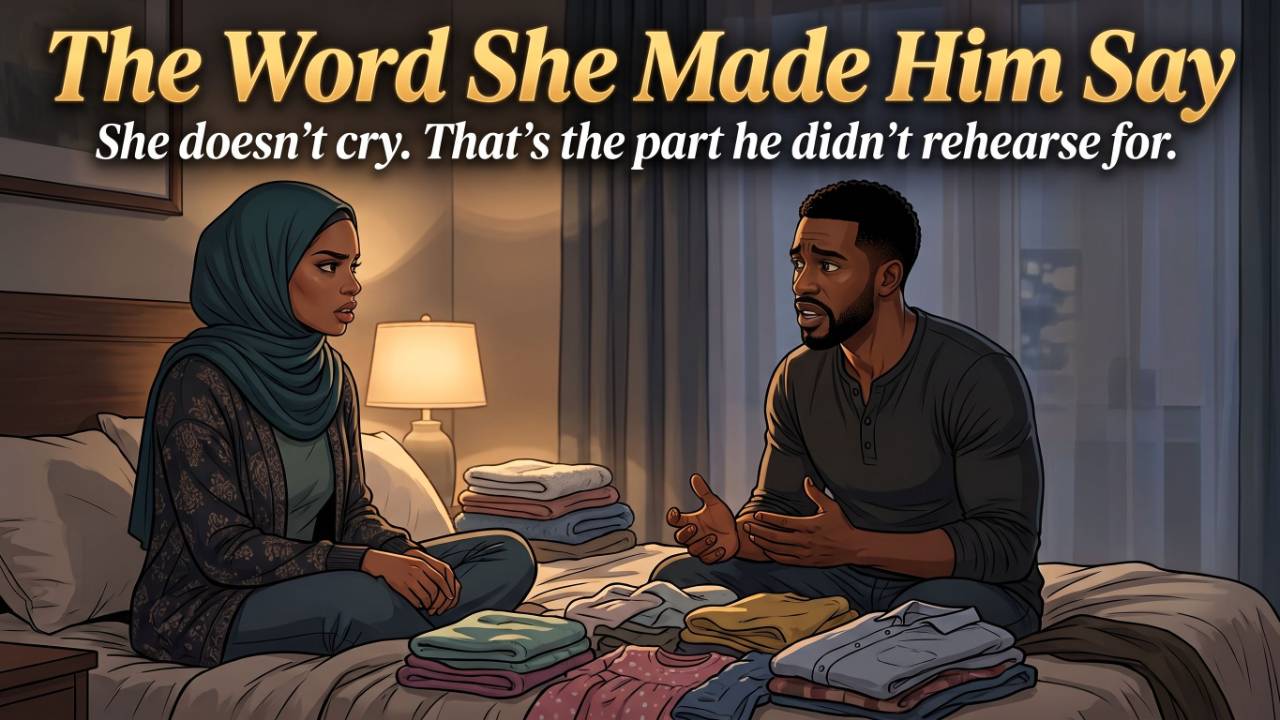
The Word She Made Him Say
She doesn't cry. That's the part he didn't rehearse for.
If You Are New Here
We're following three households this season. Episode 1 left Andre mid-sentence in front of Simone. This week, we get her side of that same ten seconds.
Andre and Simone. Married nine years, two kids. Andre just told Simone, after eleven months of carrying it alone, that he's been thinking about a second marriage.
Know your FRAME number already? Go straight to the Playbook built for it here. Haven't taken it yet? Get your score in 6 minutes here.
The Word
Simone does not cry. This is the first thing Andre notices, and it unsettles him more than tears would have.
She sits with his sentence, the unfinished one, "I've been thinking about something for a long time," for what feels to him like a full minute and is actually closer to eight seconds. Then she does something he did not rehearse for in the car, the shower, or on the fourth mile of any run.
She asks him to say the actual word.
"Say it," Simone says. Not sharp. Not soft either. The voice she uses when one of the kids is dancing around a truth instead of just telling her what broke.
Andre's throat does something complicated. He has said this word to himself for eleven months. He has said it to no one else, not even the imam he trusts, not directly, only in the careful hypothetical language men use when they are not ready to own a thing yet.
"Marriage," he says. "A second marriage."
There it is. Eleven months compressed into two words, sitting in the space between them on a bed still half covered in folded laundry.
Simone nods, slowly, the way you nod at something you suspected but had not let yourself fully suspect. She is not surprised in the way Andre feared she would be. She is surprised in a different way, quieter, more clinical, the surprise of a woman confirming a theory rather than receiving a shock.
"How long," she says. Not a question mark, really. More like she is setting down a marker for the conversation to build around.
"Eleven months."
Something moves across her face at that number. Not eleven months since he thought about it in the abstract. Eleven months of a specific, sustained, private decision, carried through two of their kids' birthdays, through a family vacation, through nights he lay next to her working out sentences he never said.
"Eleven months," she repeats. "And you're telling me tonight because."
"Because I couldn't carry it anymore alone."
What She Does With It
Here is what Simone does not do, and it matters as much as what she says.
She does not ask him to take it back. She does not cry, not yet, not in front of him. She does not reach for the easy weapon available to her, the accusation that he has been lying to her for eleven months by omission, even though a less disciplined version of her would have led with exactly that.
What she does is get quiet in a way Andre has only seen a handful of times in nine years, the specific stillness she gets when she is doing real math instead of reacting.
She thinks about her own mother, who left her father over something smaller than this and spent the next decade telling anyone who would listen that she should have stayed and fought for what the marriage could have been instead of walking. She thinks about the women at the masjid she has quietly watched for years without ever asking their situations directly, some of whom seem lighter than she expected, some of whom seem like they are carrying something they will never fully put down. She thinks about her own faith, the actual texts, not the cultural noise around them, and the fact that she has never once studied this topic seriously because she never thought she would need to.
Nine years of marriage did not prepare her for this specific conversation. But nine years of marriage to this specific man did teach her that Andre does not bring things to her half-formed. If he is finally saying it after eleven months, it is because the case, in his own mind, is finished.
That does not mean her case is finished. It means his is.
The Question He Isn't Ready For
Andre expects the conversation to go somewhere predictable from here. Anger, maybe, delayed but arriving. Or grief. Or a demand for reassurance about what this means for her, for the kids, for the marriage they already have.
What Simone asks instead stops him cold.
"Have you already talked to someone about this? Before me?"
The question is not about faith or logistics or feelings. It is about order. About whether, in the eleven months he spent building this case, she was the first person he intended to bring it to, or whether she is simply the last stop after he had already tested the idea somewhere else, with someone else, in a way that would make tonight less a decision and more a formality.
Andre opens his mouth. He has an honest answer, and it is more complicated than yes or no, and he can see, watching her face, that the eight seconds he takes to figure out how to say it are doing damage all on their own.
For Men
If you are building a case for eleven months, or eleven weeks, or eleven days, know that your wife will eventually ask some version of the question Simone just asked. Not because she assumes the worst of you, but because order matters to her in a way it may not have occurred to you to consider. Who you talked to, in what order, and why, tells her whether she is being brought into a decision or informed of one that already happened somewhere else first. Get honest with yourself about that order before you open your mouth, because she will ask, and the pause before your answer will tell her almost as much as the answer itself.
For Women
Simone's discipline here is not weakness and it is not suppression. It is a woman refusing to let her first reaction author the entire conversation. If you are on the receiving end of a sentence like this one, you are allowed to take the eight seconds, or eight days, you need before you respond with anything permanent. The version of you that reacts in the first sixty seconds is not obligated to be the version of you that decides.
Quick Self-Check
For men: If your wife asked you right now who you had already talked to about a major decision affecting your marriage, and in what order, would the honest answer make her feel brought in, or informed after the fact?
For women: When you receive news that changes everything, what does your first sixty seconds actually look like? Is it building toward clarity, or building toward a reaction you might not be able to take back?
Next Time
Andre answers her question. What he says is true, and it is also not what Simone expected to hear, and it changes the entire shape of the conversation they are about to have.
Neither of them sleeps much that night.
What Simone decides to do with what he tells her will set the direction of this marriage for the next year, and she has not decided yet.
Your Next Move
Simone isn't ready to take a quiz or book a call tonight. She's ready to see how this actually works for a real family before she decides anything. That's exactly what our weekly masterclass is for.
Coach Nazir walks through real structure, real questions, and real answers live, no pressure to decide anything by the end of it. PolygamyMasterclass.com
Your Favorite Relationship and Polygamy Coaches, Coach Nazir, Coach Fatimah, and Coach Nyla
Stay Educated, Equipped, & Engaged with private emails.

Find Out Where You Stand in Polygamy
A 6-min diagnostic used by polygamous families.